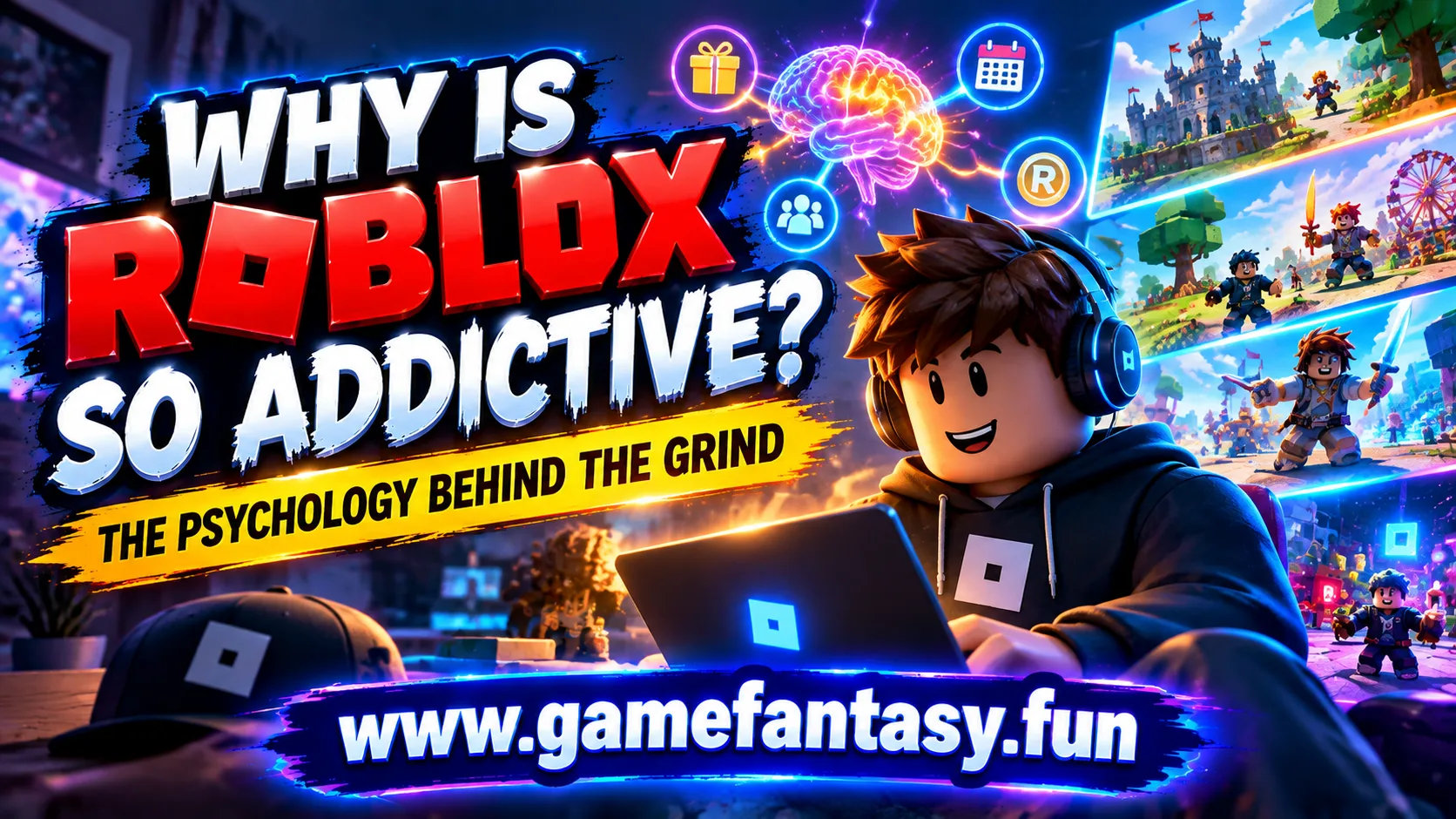
"Just one more round" has a very specific meaning if you've ever played Roblox. It's usually a lie you tell yourself around 9pm, and it's usually still a lie two hours later.
That's not really about willpower. It's about design, and once you understand which specific mechanics are pulling on you, it's a lot easier to see why "just five more minutes" almost never turns out to be true.
Roblox Isn't One Game, It's Thousands
The first thing worth understanding is that Roblox isn't a single game the way Minecraft or Fortnite is. It's a platform hosting millions of separate experiences built by independent creators, each competing for the same pool of attention.
That competition matters more than people realize. When thousands of creators are all fighting to keep players inside their specific experience instead of the one next door, the ones who succeed tend to be the ones who lean hardest into whatever keeps people engaged the longest. There's no single design team deciding how addictive the platform should feel. There's a marketplace of creators, and the ones using the stickiest mechanics usually end up on top of the charts.
The Reward Loop Underneath It
Most of what makes Roblox hard to put down comes down to a fairly old psychological principle: variable reward.
You don't know exactly when you'll get a rare item, finish a challenging objective, or unlock something new. That uncertainty is the actual hook. Predictable rewards stop feeling exciting fast, but a reward that might show up on this attempt, or the next one, or the one after that, keeps your brain in a state of low-grade anticipation the entire time you're playing. It's the same mechanism behind slot machines, just wrapped in a cheerful avatar and a colorful world instead of flashing lights.
Layered on top of that are a handful of familiar hooks. Daily login streaks that reward showing up on consecutive days. Limited-time items that create urgency because they'll be gone soon. A virtual currency, Robux, that turns real spending into something abstract enough that it stops feeling like actual money. None of these individually would be that powerful. Together, they add up to something a lot harder to walk away from than any single mechanic on its own.
Why It's Especially Sticky for Kids
A lot of the concern around Roblox specifically, rather than gaming in general, comes from how young its core audience skews.
Identity is still forming during childhood and adolescence, and Roblox gives players a lot of room to build one inside the platform: custom avatars, leadership roles inside cooperative experiences, social status tied to rare items or achievements. For a kid who feels overlooked elsewhere, that identity can feel genuinely meaningful, which is exactly why stepping away from it can feel like more than just closing an app. It's less like putting down a toy and more like temporarily leaving behind a version of yourself that other people actually respond to.
This has moved beyond casual concern into actual legal territory. Several lawsuits have alleged that Roblox intentionally used behavioral psychology, including consultation with psychologists, to maximize the time young users spend on the platform. Roblox has positioned itself publicly as a creativity and education tool rather than a game designed to be habit-forming. Both things get said constantly, and neither claim fully resolves the other. What's not really in dispute is that the mechanics themselves, variable rewards, streaks, social pressure, do exactly what critics describe, regardless of what the original intent behind building them was.
It's Not Purely Manipulation Either
It's worth being fair to the other side of this too. Roblox does give a real outlet for creative and technical skills that a lot of other platforms don't. Kids who build their own experiences are genuinely learning basic programming logic, game design, and even early entrepreneurship, since successful creators can earn real money from popular experiences. A kid who struggles academically in a traditional classroom setting sometimes finds a kind of confidence in Roblox that they don't find anywhere else.
That doesn't cancel out the reward-loop criticism. It just means the platform isn't purely one thing or the other. The creative upside is real. So is the engineered stickiness sitting right next to it. Most criticism of Roblox that's worth taking seriously acknowledges both instead of pretending only one side exists.
What Actually Keeps People Coming Back
A few specific features do most of the heavy lifting here:
- Endless content. There's no ending to reach, no credits to roll. When one experience gets boring, there are millions more waiting, so there's never a natural stopping point built into the platform itself.
- Social pressure. Friends online, group activities, and shared progress all make logging off feel like missing out on something happening without you.
- Achievement badges. Small, frequent markers of progress that reward simply showing up repeatedly, not just skill or effort.
- A real-money economy. Robux converts actual currency into in-game spending, and the psychological distance that creates between "money" and "points" tends to lower the resistance people normally feel before spending.
None of these are unique inventions of Roblox specifically. They show up across most free-to-play platforms in some form, from mobile games to live-service titles on consoles. What's unusual about Roblox is how many of them are stacked together at once, across thousands of separately built experiences all optimizing for the same outcome, without any single company deciding where the line should be drawn.
Funnily enough, the "just one more try" pull isn't unique to platforms as big as Roblox either. Tower Builder, a simple stacking game where you try to build the tallest, most aligned tower possible, runs on a similar one-more-attempt loop, just on a much smaller and more contained scale. The difference is that a round ends in under a minute, and there's no streak, currency, or social pressure keeping you there afterward. It's the same basic hook, without the machinery built around it to stretch that hook into hours.
Playing It Without Losing an Entire Evening
None of this means the platform isn't genuinely fun, or that understanding the mechanics ruins the experience. It mostly just means going in aware of what's actually happening tends to help.
Setting an actual time limit before starting a session, rather than deciding "when it feels like a good stopping point," works better precisely because the design is built to make every stopping point feel slightly premature. Treating daily streaks and limited-time events as optional rather than obligations helps too, since a lot of the pressure to log in specifically today is manufactured rather than necessary.
If you want something that fills a short break without the same open-ended reward loop, browser games with a clear start and end tend to work differently by design. Game Fantasy's library runs on single sessions with no login streaks, no virtual currency, and no engineered urgency to come back at a specific time, which makes it a genuinely different kind of five minutes than opening a platform built around never quite finishing.
Understanding why something is engineered to be hard to put down doesn't make it less fun. It just makes it a choice instead of a habit you didn't fully sign up for.